A calmer reading app
I’ve been thinking about how reading apps could take a different tack. How they could be calmer.
For me, 2011 is the year of the reader. Essential technologies such as pixel density and screen typography are at last reaching comfortable standards, and after years of being treated as mere eyeballs and drivers of ad revenue, users finally have tools that help them regain control of the reading experience.
On the surface, tools like Instapaper, Safari Reader and the updated Readability are simply the logical continuation of the separation of presentation from content. However, I see them as embryonic oracles of the era of content shifting, in which users will push text, photos and videos between devices and contexts far removed from their current habitats. There will be substantial implications for publishing, information architecture, advertising, and design, which I’ll discuss in a future article. But for now, let’s look at the applications themselves:

Instapaper has become an essential part of my digital life, and I’m intrigued by the promise of Readability, above. However, I do feel the current crop of reading applications take too technical an approach to the art of reading. So much of our digital lives is spent pushing undone tasks from one service to another: emails to Things, RSS to a sprawling folder of “Unsorted bookmarks”. You’d be forgiven for thinking that the modern digital native is mostly concerned with reducing big numbers to zero.
So I’ve been thinking about how reading apps could take a different tack. How they could be calmer. How they could leave the to-read pressure behind and restore some enjoyment to reading. As a thought experiment, I’ve been sketching some thoughts on a hypothetical reading app: let’s call it CalmReader.

The primary design principle of CalmReader is that users should feel empowered to go with the flow, not to fight the tide. Don’t try to read everything, but do read something. CalmReader should be seen as a scrapbook, not a to-do list. Users should be encouraged to add as many articles as they like without fear of guilt at not reading them; with a Readability or Flattr-esque micropayment mechanism underlying the app, this is obviously good news for publishers.
CalmReader has no unread count. Unread counts suck the joy out of life, and the trivial pride of reaching zero is quickly crushed by inevitable new tasks. Unread counts are tolerable within to task-orientated environments like email, but within a reading application they reinforce the undesirable mentality of Keeping On Top Of Stuff, rather than enjoyment.
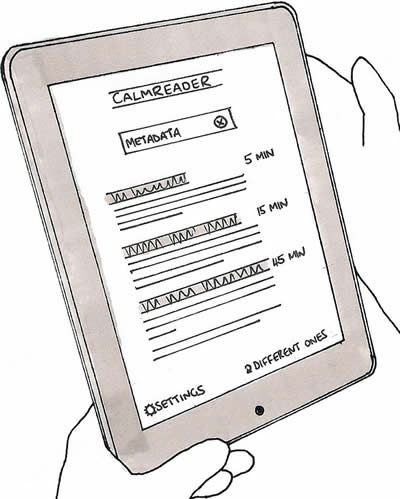
An estimated reading time accompanies each article, calculated from its word count. It’s harder to estimate the scale of a digital work than its physical counterpart, since we can’t skim to the end or feel the paper it’s printed on. The reading time estimate helps users to fit reading around their schedules, reducing the chance they’ll have to abandon an article halfway through. It also promotes the understanding that it’s OK to graze on short articles. Reading needn’t be just about marathons of concentration.
Article ordering is particularly important to CalmReader. The reverse chronological order – newest on top – seen in Instapaper and Readability doesn’t suit the calm mindset. Since newer articles persistently suppress older articles, reverse chronology risks creating a backlog of articles that you never get round to reading. Thus reading becomes equated with embarrassing procrastination. Instead of the full backlog, CalmReader shows just three articles when opened, guided by an algorithm that balances randomness, popularity and recency (more on that below). It displays the first few sentences to jog your memory and help you decide, but if these articles don’t take your fancy, tap the Different ones link and it will refresh the list.
This cherry-picking approach is deliberately non-comprehensive, meaning that CalmReader acts more as a reading suggestion service than a library of everything you’ve bookmarked. One downside of this approach is that it potentially hinders findability of specific articles. Scale exacerbates the problem: if you’ve added hundreds of articles, a graphical interface soon becomes cumbersome. Therefore, search plays a central role in CalmReader. Users can enter a search query to help them find a specific article (“Bahrain”), or to find articles that contain topic keywords of interest at that moment (“sport”, “design”, “pop”). To add richness, CalmReader adds hidden tags to each new URL (using the Delicious API, for example) – so a topic-based search like “Middle East” still retrieves articles that don’t feature the specific text.
We might also use APIs to harvest popularity metadata from social services such as Tweetmeme or Reddit. CalmReader then displays a simple preferences screen to allow users to give gentle weighting to either popular or lesser-known articles, for users who want to stray off the beaten track. Users can also bias the selection algorithm toward older or fresher material. This potentially complex weighting algorithm is largely hidden from the user. No need to expose the inner workings; it’s a simple reading app, after all.

So there we have it: just an experiment, and not one I’ll build (feel free to build it yourself if you like – ideas are cheap). But it’s interesting to consider how a few small design tweaks might fundamentally affect the nature of reading applications and remove some of the guilt that lingers around them. The world could use a little less stress.
UX writing retreat
Our mobiles have latched on to the French networks and pushed our clocks onto continental time. An hour lost, an hour gained, it doesn’t matter. Time is unimportant here.
I write this in the lounge of a grand house overlooking the English Channel. The architecture feels faintly colonial: three balconies, high ceilings and flaking white paint. Our mobiles have latched on to the French networks and pushed our clocks onto continental time. An hour lost, an hour gained, it doesn’t matter. Time is unimportant here.

And that’s the point. Eight of us have gathered here for a long weekend to write and to think. For some, it’s a chance to blog. Others plan larger projects. We try to ignore the WiFi and instead discuss information architecture, mentoring, and the job market. We talk about our favourite books and bemoan the lack of unbridled joy in design literature.
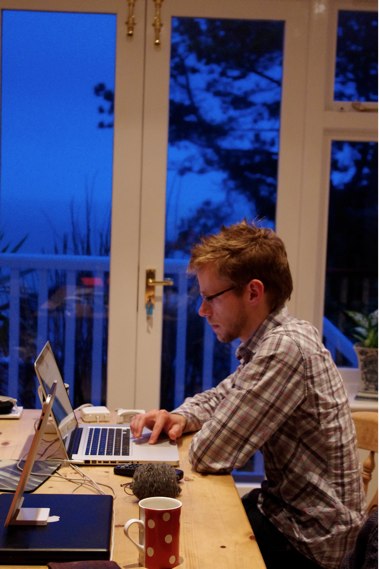
The sound of the wind and the waves is indistinguishable. Of course we chose February to save money, but I’m keen also to embrace the bleak romance of the English winter. It’s a suitably wild and blustery weekend and, once we find the thermostat, we huddle together over glowing rectangles and cups of tea. Various tools of the trade emerge: Scrivener, WriteRoom, Writer, Ommwriter, TextEdit. iPads, PCs, Macs, pens and paper. In the evenings we seek out the local pubs, armed with flashlights, obvious tourists in this quiet village.
It’s a somewhat melancholy wind-down as people drift away early to prepare for a week of work. (In retrospect, a Monday off is too easy to sacrifice.) I watch the ferries slither to the West and debate whether that’s Calais I can see, or just a watery horizon.

It’s been a successful weekend. A clearing of the cobwebs, and a chance to slow down and create without distraction. We need more of these downtempo moments.
Attendees: Cennydd Bowles, Matthew Solle, Ian Fenn, Mags Hanley, Tyler Tate, Ann McMeekin, Amanda Wright, Sjors Timmer
The role of taste in design
My theory is that, as in chess, “taste” is simply the ability to draw on patterns and experience to help us choose better candidates for analysis.

Photo by All Glass Photo.
While other teenagers chased the opposite sex and drank their parents’ cider, I played chess. Bobby Fischer was my Holden Caulfield; a gifted but flawed antihero. At university, my chess career dropped off as I caught up on the excitement I’d missed, but the mark was made, and I still play from time to time. I’ve even played a few Grandmasters, with little success.
Most people think that Grandmasters are stronger players because they “see further ahead”. It’s true that they examine branches of play more deeply than the average player, but the difference is slight. A couple of moves perhaps, but not enough to explain the gulf in skill.
Instead, the main difference is that strong players instinctively select good moves to analyse in the first place. Somehow, masters screen out bad moves without the need for deep analysis. Ask these players to explain this process and they struggle – all they can say is that they intuitively knew certain moves were more promising than others. It’s as if skilled players have developed “taste” for chess moves.
Psychologist Adriaan de Groot’s studies show that the process of playing chess is more akin to the design process than to mathematical reasoning. Both chess and design revolve around visual memory and spatial reasoning. Both involve a phase of orientation, exploration, investigation and validation. And both have enormous branching factors. The permutations of design are limited only by constraints and imagination, while the number of chess games of just three moves each numbers over nine million. De Groot explains that the discernment showed by skilled players is closely related to pattern matching. Grandmasters are thought to have learned up to 100,000 chess patterns and moves, which helps them to develop a feel for the right move in the circumstances.
So what role does taste play in the design process? My theory is that, as in chess, “taste” is simply the ability to draw on patterns and experience to help us choose better candidates for analysis. As such, good taste improves efficiency. An experienced designer doesn’t waste time on clearly ineffective solutions: typographically poor designs, bad colour choice, or unusable interaction metaphors. It follows that taste is learned, not innate. Experience, exposure, and practice give us patterns that suggest which solutions might fit which problems.
There are, however, more cautionary interpretations. Some critics and philosophers contend that taste is merely an exercise in reinforcing social hierarchy: the upper class has taste, the middle class aspires to it, and the lower class lacks it. According to this theory, “taste” is a value judgment about what is beautiful, desirable and proper in the world.
This leads us to the troubling thought that perhaps professional designers perpetuate their existence by claiming that only they possess taste. To avoid this elitist trap, we must expose ourselves to variety in design. This means embracing the low brow with the aristocratic, the kitsch with the refined, the masculine and the feminine. We should let go of the notion that only a designer can produce a tasteful solution, and revel in the ingenuity of the hack and the quick fix.
Whatever the definition, taste alone isn’t sufficient for good design. Give a Grandmaster two hours to play a game and they’ll play substantially better than if you give them five minutes. Promising solutions must still be examined thoroughly. This analysis – visual prediction, updating our approaches as we find flaws or learn more about the features of the problem – is the heart of the design process. Anyone who claims that taste alone justifies their design is misguided if not arrogant.
Postscript
Several years after graduation, I grew nostalgic for the tick of the chess clock and joined a local league. A strange thing had happened. My grade, the quantification of chess skill, had leapt from a mediocre 79 to a respectable 125 (1700 USCF, for American readers). Yet I’d not practised, kept up to date with opening theory, or played more than a handful of one-sided casual games. How, in ten years of lapsed play, had I become a better chess player?
Now I know. I became a designer.
Further reading
Updating Nottingham’s tram graphics
Nottingham’s tram system NET is regarded as one of the most successful urban light rail systems in Europe. I commuted on it daily from its opening in 2004 until I moved away, and remember it fondly when stuck on an uncomfortable Underground journey.
Nottingham’s tram system NET is regarded as one of the most successful urban light rail systems in Europe. I commuted on it daily from its opening in 2004 until I moved away, and remember it fondly when stuck on an uncomfortable Underground journey.
Soon after its launch, I blogged about the information design of the tram’s timetable and fare posters, praising their skilful combination of clarity and information density.
Thinking about the project started what has become a deep interest in wayfinding and helped me appreciate the value of environmental graphic design: design that helps people navigate, communicates location identity, and shapes the idea of place.
Happily, the display’s designer Eleanor Seelig saw my post and contacted me recently to let me know that an update was in the works. I asked her for a few words about the project.
The first design was done a few months after the launch when the system was still very new to Nottingham. The brief focused on introducing the tram to Nottingham, but in a way that pitched the brand as higher class public transport. It was important to persuade people out of their cars and onto public transport by selling the benefits clearly. This resulted in a huge amount of information to include, which possibly became a struggle between usefulness and promotion. When I came to design the second version, the tram had just celebrated its sixth birthday and was now securely part of the landscape of Nottingham. In reviewing the existing design, it suddenly felt very cramped. Plenty of the information was out of date and, due to many small changes and the need to squeeze in yet more information over the years, not very clear.
You can see the new map in full at the NET website (PDF format). The update’s main goal has been to reprioritise information to suit users’ recent needs. The rapid adoption of the tram has meant that it is very familiar to Nottingham’s residents, with recent fare adjustments becoming of higher priority than line and geographical information. To save reprinting costs, some of the more rapidly-changing local detail has been omitted, and transport links have been rolled into the redrawn line map.
I knew the fare information was really quite complicated to communicate, with lots of ticket types and even different fares for different times of the day. So I used the coloured fare buttons to draw the viewer into to the fares that would be most relevant to them when standing at the stop – it’s a bit frustrating to find out how cheap a season ticket is when all you want to know is what it’s going to cost you today.
There were also several functional restraints to take into consideration. Each stop has its own timetable and because of the design of the system, this means that stops have between one and three separate panels of times. So I needed to incorporate some ‘filler’ information for certain stops. All in all, there are 46 stop boards, with 32 variations, so it’s a bit of a complicated job.
I was a fan of the open feel of the original version, and on a purely aesthetic level I preferred it to the more boxy and masculine update. I also think it’s a shame that the client has clearly pushed the design toward being a vehicle for promotion rather than information (the “Tram it!” campaign is somewhat ridiculous). But generally I think this is a decent user-centred update of an excellent design.
I’m happy to see that the stem-and-leaf timetable structure is still intact and I agree with the deprecation of local information. Interesting though it was, for the majority of city residents this information was simply unnecessary.
Finally, Eleanor’s copy revisions improve the instructional tone of voice, putting a more approachable face to the service.
I felt some of the information was a little too gruff and off-putting in its tone of voice, so I rewrote the ‘Using the tram’ panel to make it a little friendlier and less authoritative.

Bravo to Eleanor and NET for continuing to demonstrate how good design can make urban transport a little more accessible. I’m looking forward to seeing how NET will update its wayfinding and information graphics with the future introduction of Lines 2 and 3.
Content Strategy Applied in review
The field’s abstract leanings have attracted the attention of those who’ve considered content a downstream function, but have also proven too elusive for some. At last, we had a chance to see the nuts and bolts.
The practical direction of Content Strategy Applied, the UK’s first CS conference, was a smart move. The field’s abstract leanings have attracted the attention of those who’ve considered content a downstream function, but have also proven too elusive for some. At last, we had a chance to see the nuts and bolts.
The two days gave a wide view of the discipline, from a tour of the values, content and community of JamieOliver.com (courtesy of Monisha Saldanha and Danny McCubbin) to deliverable detail from LBi‘s Head of Content Julie Mahoney. Unsurprisingly, there were clear parallels with the early days of information architecture. Content strategists are gaining strength from recognising common ground and joining with others. The conversation is moving from stealth—“What is it you do again?“—to genuine influence—“We get it. Now what can you do for us?”. As such, the community’s challenges are familiar to any UX veteran: learning the language of business, demonstrating ROI, getting a seat at the strategy table.
The similarities extend from the communities’ lifecycles to the landscape under discussion. I’ll admit that my first instinct was to react defensively to the territorial issues. Should content strategists really do wireframes and layout work? Do they have the library and information skills required to create large site architectures? Aren’t these “content fails” you’re showing simply WebPagesThatSuck-era usability?
But there’s no need to feel threatened. Although CS and IA are approaching the same battleground, it is as allies. Our goals are largely indistinguishable, and once the armies meet we will better appreciate both the vocabulary and history of the other force: LIS and design on one side, writing and publishing on the other.
That’s not to say that friendly rivalry is out of the question. Keynoter Kristina Halvorson in particular has taken aim at the UX community’s content-ignorant approaches, and she continued by teasing the sacred cows of JJG and Tufte. All in good sport, but some underlying subtexts of the conference did make me feel less at home. Publishing and marketing reverberated throughout, with the word audience far more prevalent than user. Presenters spoke of how companies can present themselves through brand, messaging hierarchy, and calls to action, but there was less of what users need and want. User experience attendees were thin on the ground, and more focus on this angle next time would resonate better with the UX community.
With time, the community’s presentation skills will improve too. As expected the content was strong, but to be blunt, the design community has the CS community licked when it comes to compelling presentations. However, message is more important than showmanship. Content Strategy Applied tried to unite the nascent British CS community, share ideas, and inspire through good practice. Mission accomplished, and hopefully it can act as a stepping stone for the community to earn further influence.
The intangible brand
To paraphrase Marty Neumeier, a brand is the intangible public perception of a product or organisation. A gut feeling. A collective hallucination.
The use of “brand” and “company” as interchangeable words—“Food brand Kraft hires new Creative Director“—bugs me. My issue is not its association with flimsy new media marketese, but that it simply misrepresents the concepts. To paraphrase Marty Neumeier, a brand is the intangible public perception of a product or organisation. A gut feeling. A collective hallucination. A company makes stuff, but people buy because of the brand.
My bonus definition: a brand = user experience + non-user experience. It seems to work well for me.
(Suffering from bloggers’ disease lately: the paralysis that results from trying to reach the skies with every post. Expect more frequent snacking to accompany the main courses.)
The year gone by
Please indulge me for the customary year-end contemplation.
Please indulge me for the customary year-end contemplation.
I’ve recently returned from a family break in Cornwall; a chance to repay my sleep debt, help around the house, and rediscover the warmth of a novel. In quiet moments I watched a fox inch across the garden, wagtails bounce on the patio, acrobatic squirrels wrap their haunches around the bird feeder. Seems I’m becoming more sentimental about the natural world as I get older.
The break was also a chance to take stock of a dizzying year. Although 2010 has been fruitful, burnout has stalked me like a shadow. I can’t sustain the tempo, so next year’s themes will be enjoyment, travel, and the opportunity to breathe the air.
I’m keen to do more public speaking and have a few gigs already lined up, not least the plenary. I also want to write more. This year I’ve been seduced by the romance of the written word—and experienced its occasional drudgery—and I now regard myself as both a designer and a writer. Design will always be my passion and pay my bills, but next year I hope to broaden my writing horizons and scratch out whatever reward I can earn. I’m not yet ready to write another book, but please bear me in mind if you have any suitable projects.
Finally, I must confess that it’s been a year of maturation. I’ve learned a lot about the humbling experience of having an audience. I’ve surprised myself with my determination and occasional temper. But above all, I’ve found that my love for what I do is stronger than ever. And for that, I’m truly thankful.
See you next year.
Behaviour change
Evidence that, despite my scepticism, there’s something in this technology-as-behaviour-change-catalyst argument.
Here’s a graph showing how many articles I’ve saved to Delicious each day since 1 July (moving average). My Kindle arrived on 22 September. Evidence that, despite my scepticism, there’s something in this technology-as-behaviour-change-catalyst argument.

On UX and advertising
Can UX designers make a difference in the advertising field? Possibly. But I see it as a a quixotic endeavour, swimming against the tide of a value system that frequently causes the disempowerment of the user.
Peter Merholz’s rant The Pernicious Effects of Advertising and Marketing Agencies Trying To Deliver User Experience Design is bold, uncomfortable and dogmatic, as all rants should be. I too have been thinking hard about the role of UX in advertising and, reaching similar conclusions, rushed to slap Peter’s back. However, my comments were somewhat splenetic after a difficult week, and after some time to think (and yes, to feel some of the sting of the backlash too), I’d like to make a more reasoned case for the offense.
I’ve never worked in an ad agency. However, I’ve mentored and befriended enough designers in the industry to recognise many of the patterns that Peter condemns. Harmful practices such as spec work, bait and switch, and employee exploitation pervade a worrying proportion of the agency world. So the post is a heavy punch, but a fair one. And I’m glad that, ignoring a few blow-the-belt blows, the critical reaction has been constructive. Most of it, of course, comes from ad agency designers who feel hurt by the article. They have fought their corner and accused Peter of tarring all agencies with the same brush. It’s a fair counter, but to shrug our shoulders and blame the other guy doesn’t make the smell disappear.
Are all ad agencies “soulless holes”? No, but some certainly are. Can UX designers make a difference in the advertising field? Possibly. But I see it as a a quixotic endeavour, swimming against the tide of a value system that frequently causes the disempowerment of the user. So I stand by my comment that a UX designer at an ad agency is an oxymoron. I have never made a “campaign site”. Nor will I, particularly after this post. To me, user-centred design must have higher aims, and I don’t understand how a UX designer can be excited or rewarded working on advertising projects.
And this, to me, is the crux of the debate. Peter’s post is an ideological gambit, and an old one at that: First Things First for the next generation. The debate was, and is, unwinnable as it revolves around sacrosanct personal values. Those who subscribe to the worldview that “advertising as it is widely practiced is an inherently unethical and, frankly, poisonous endeavor” (for the avoidance of doubt, clearly I do – but note my italicisation) will approve of Peter’s stance. Others won’t.
So far, so idealistic, and I know well that my belief in turning design toward The World’s Big Problems will be seen as naive or elitist. But just because an argument is unwinnable it doesn’t mean it’s not worth having. Difficult, scary questions lie beneath the surface of the post, although for some readers the aggressive language caused those questions to be lost in the froth. How do we come to terms with the fact that a wide range of organisations now practise (or claim to practise) user experience design? How will this affect the perceived value of our work? Does user-centred design contain values that conflict with a capitalist society? How do we decide which projects are most worthy of our attention, and is it right for designers to play the role of ethical judiciary?
These are questions that truly matter in our industry, and I hope the conversation can move beyond personal affront and politics. If it can, then I think Peter’s role as agent provocateur will have been worthwhile, whatever your feelings about his comments.
Update: Peter’s followup post.
Closing the IA Summit 2011
Several weeks ago, I opened a late-night email from Livia Labate, the IA Summit conference chair. I responded with blinking disbelief, the sort you get upon learning you were raised by wolves.

Finally, I can reveal that I’ll be giving the closing plenary at the 2011 IA Summit in Denver, Colorado.
Several weeks ago, I opened a late-night email from Livia Labate, the IA Summit conference chair. I responded with blinking disbelief, the sort you get upon learning you were raised by wolves.
Needless to say, to give the closing plenary is both an immense honour and surprise. Sure, I write a lot and talk a bit, but my achievements pale in comparison to those of my illustrious predecessors: Andrew Dillon, Peter Merholz, Rashmi Sinha, Andrew Hinton, Jesse James Garett and Whitney Hess. So for weeks now I’ve been thinking hard about what I can bring to the role, researching and synthesising the topics that truly matter in user experience today.
One noteworthy point is that, as far as I can tell, I will be the first non-American to give either a closing plenary or the opening keynote at the IA Summit. I see this as a tribute to the growth of the European and British UX communities, and I’ll certainly be using this opportunity to discuss the realities and implications of global practice.
Wherever you hail from, I’d be delighted if you’d like to join me at the IA Summit. There are ten days left to submit a proposal, and successful presenters receive a complimentary ticket. But it’s not just about the sessions. The IA Summit is about community, putting names to faces, and learning from the wisdom of others. I’m thrilled to be a part of its history.
End hover abuse now
All around the web, hover states are being abused, and only you can put a stop to it.

All around the web, hover states are being abused. Let’s put a stop to it.
Whatever a mouse user is doing, they are perpetually hovering. They may be hovering over a specific control, or over several places in the course of another action: dragging a scrollbar, selecting a word, even just idling around the screen. But until they click, the user has taken no positive action. A click is unambiguous: the caveman pointing at the mammoth, the dog scratching at the door to go out. It cannot be done in the course of anything else.
Hover states can provide subtle visual cues that help the user understand how something works. A faint glow around a “favourite” star. An underline appearing underneath a link. But they should not be used for anything else. Hovering does not demonstrate intent.
Designers who pop up information panels or move page elements on hover are using flawed logic, second-guessing what users want to do before they do it. The result, which I’ve seen in countless usability tests, is that users activate these controls accidentally. You know what happens? People actually flinch: “What was that?” They return with hesitation, less confident in their understanding of the site. It’s no accident that the Twitter worm propagated through hover—accidental activation meant users spread the worm unintentionally.
You may argue that hover states save space, and you can use hover panels to display supplementary information that helps the user know whether to click. It’s a feeble excuse. If the information is important, it should be on the screen already; if not, it should be omitted. The hover compromise shows only that you were too timid to make this decision.
Another compelling reason not to hide information behind hover is that you can’t rely on hover states even existing. The approach prioritises just one mode of input—the mouse—and makes information unavailable to people using keyboards, touchscreens and screenreaders. That’s not what your parents taught you.
Please, do your part. End hover abuse now.
Addendum: If you positively have to use hover popups, at least add a delay so they only activate if the user hovers for >500ms. It’s still no guarantee of intent, but it makes it a more likely probability.
Instapaper & the Kindle
For now, my Kindle has found its niche just serving me Instapaper articles. Sure, the integration is hacky, but it comes with an odd curatorial satisfaction, just like loading the iPod in the old days.
Instapaper is where best intentions go to die.
Don’t get me wrong: it’s a fine service. But its simplicity predestines it to serve as a final resting place for the written word. While the iPhone app is pleasant enough for grouting the quieter moments of my day, reading is still a pokey experience. Instead, I typically succumb to games or email, the weight of words growing heavier until shamefully purged.
So I bought a Kindle.
Some technophiles scoff at single-purpose devices. No features! Get an iPad instead! And yes, the Kindle is a limited beast. A laughable browser. Prehistoric syncing. Awkward interaction design. But the reading experience is generally good, and this is why the Kindle is an interesting device. The e-ink display makes long articles a pleasure to read—which is fortunate, because of course there’s nothing else to do. The Kindle allows no access to the black hole of email, games or social networking, much to its benefit.
That’s not to say I’m entirely sold on the Kindle ecosystem. I’m still unconvinced by the idea of buying books in Kindle format, due to DRM and my reluctance to only license something that I ought to own. For now, my Kindle has found its niche just serving me Instapaper articles. Sure, the integration is hacky, but it comes with an odd curatorial satisfaction, just like loading the iPod in the old days.
With my enforced RSI breaks adding up, I’m devouring upward of twenty articles a day (Dan Saffer’s list of canonical interaction design articles has provided ample food for thought). Between them, the Kindle and Instapaper have exposed me to a host of fresh perspectives—and that’s surely among the highest praise technology can earn.
Undercover UX Design out now
At last, the book’s rolled off the printers and is in stock at all good online bookshops.
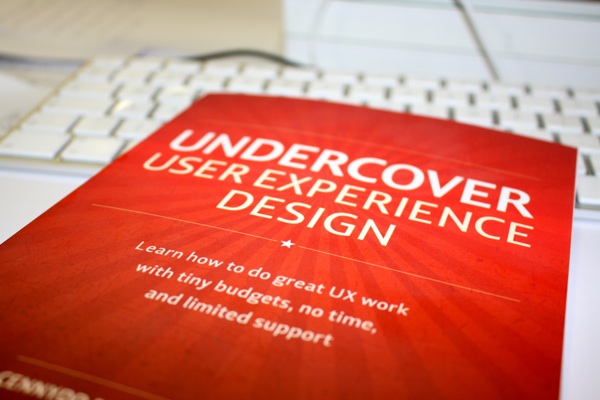
At last, the book’s rolled off the printers and is in stock at all good online bookshops. You can now buy the paperback on Amazon UK for £11 or Amazon US for $20. If digital formats are more your thing, it’s also available on Kindle: Kindle UK (£10) or Kindle US ($16). An ePub version (for iPad etc) is also in the works, release date TBC.
We’ve given interviews for UX Booth and Scrunchup about the book, and there’s a short excerpt Winning a user experience debate on UX Booth too. Early reactions have been very positive, and sales have been brisk, so we’re pleased with the end result. I’ve been particularly humbled to see so many friends and colleagues industry grab a copy. That said, Undercover User Experience Design isn’t really a book for the senior conference-going elite. If you’re a junior-to-mid UX professional, or a developer/designer/etc looking to introduce user-centred ideas into your business, UUXD should be right up your street.
Finally, if you’ve read and enjoyed the book, please do consider leaving a review on Amazon. It makes a huge difference, and we’d be very grateful.
The heat death of the digital universe
Digital environments undergo an aging process more aggressive than mere erosion. This aging is not caused by the degradation of the environment, which stays as faithfully preserved as at its creation. Instead, the value of our digital worlds is eroded by relative decrepitude
For a while, I was a Final Fantasy XI addict. My equipment was top-notch, my White Mage and Bard fully levelled, and I could navigate Vana’diel better than my hometown. As an officer in a successful “linkshell”, I endured and mediated the drama that competitive internet anonymity creates, and made some good friends along the way. I even shifted my body clock for a week to complete the infamous Chains of Promathia missions with my East Coast buddies. However, the urge to spend time on other pursuits—namely design—eventually grew too strong, and in 2005 I donated my precious equipment, embarked on a suicidal tour of the game’s most difficult foes, and logged off for the final time.
Last month, unable to suppress my curiosity, I briefly rejoined FFXI.
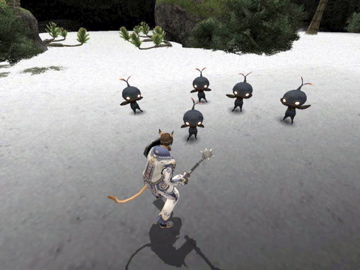
Although the game’s mechanics are largely unchanged, the designers have given belated thought to the beginners’ experience. The fearsome learning curve has been softened thanks to a tutorial, benevolent sprites to help newbies in distress and new trials to allow players to gain their first few levels quickly. No doubt spurred by customer retention metrics, the game’s designers have tried to create a more enjoyable newcomer experience.
Their attempts have failed.
Designers of MMOs (massively multiplayer online games) provide the game mechanics such as the architecture of the game world, the appearance and behaviour of enemies, and rules for movement and combat. But the primary architecture of an MMO is social. While game design provides the initial impetus to explore and level up, the thirst for experience points soon dries up without social context. FFXI’s original design acknowledges this, and encourages player collaboration by rewarding efficient party-based levelling. Thus a new player is quickly thrown into a social world, meeting other players with whom they can explore team-based missions and, finally, “endgame” content such as defeating Notorious Monsters. The fundamental premise of player versus AI foe continues all the way to the highest levels, but teamwork is essential at all times. Even the endgame reward system is socialised, as many boss battles only reward players with raw materials that must then be synthesised by another player. Value is created largely by users—all the game designers can do is trickle currency and items into the system and watch as they are bought, sold and reconfigured. The game outside of combat becomes largely an exercise of socioeconomics and commerce, with markets rife with inflation and deflation, supply and demand, and sharing of resources among clans and friends.
Although there is intrinsic reward in defeating a formidable opponent, social capital is the driving force in endgame play. Defeating Notorious Monsters grants players a title visible to all. Members of exclusive endgame linkshells, who hunt these monsters, wear their allegiance like a badge of honour. Even altruistic acts like raising fallen colleagues help to build reputation in the eyes of others.
In 2005, I was part of this world of interaction, rivalry and friendship. But almost all of my friends have now quit FFXI (endgame play tries your patience after a while), meaning this social incentive is missing from the game today. The shared exploration of the early days—such as being the first on our server to discover, and quixotically attack, Cerberus—has long gone.
FFXI is now a lonely experience for the new player. Experienced players hang around in ever-expanding high-level areas, where they can mingle with players of equal experience and trade endgame equipment. As a lowly level 14 character, these areas were off-limits. I was never once invited to join a levelling party and, since I kept my elite history concealed, established players assumed I had little of value to tell them. Instead of a social experience—a community bonding around the rules of the game—FFXI now feels joyless and isolated. For all their attempts to improve the newcomer’s experience of the game itself, the designers can do little to improve the social experience.
Virtual worlds in their dotage
Square Enix won’t want to lose the revenue from a relatively successful game, and have just appointed a new director to guide the game’s future development. But with a sequel just days away, new players are no longer the focus, minor gestures aside. Instead, the designers will continue to support the endgame activities of their existing, committed userbase. The time investment and social capital these players have built up will mean some keep their accounts, but many FFXI players will soon migrate to the sequel. I expect that FFXI will therefore implode in the foreseeable future. As resources are poured into the sequel, development of new content will cease, and eventually the maintenance costs will exceed revenue. Vana’diel will die, taking with it the memories and stories that took place within its territories.
(If a tree falls in an uninhabited digital forest, does it play a sound file?)
FFXI has had remarkable longevity, but the game is no longer fit for new players. In concentrating on endgame activity, the designers have (perhaps deliberately) caused the social architectures around low-level play to vanish. Where new players once experienced a rich world of social value, economics and interaction, they are now left with a mere game of player against environment.
Digital environments undergo an ageing process more aggressive than mere erosion. This ageing is not caused by the degradation of the environment, which stays as faithfully preserved as at its creation. Instead, the value of our digital worlds is eroded by relative decrepitude. Our games, our websites, our interfaces are soon rendered obsolete by more fully-realised alternatives. Final Fantasy XI loses to Final Fantasy XIV. MySpace loses to Facebook. The lure of the new feature set, the redesign, the higher polygon count is hard to resist. The death of our digital environments—websites, MMOs, operating systems—is inevitable. Entropy always wins.
Perhaps nostalgic sentimentality has no place in our futurist outlook, but in our eagerness to create the new we should consider the human experiences that lie within the walls of our antiquated structures. Designing to conserve experience, perhaps, is the digital industry’s sustainability challenge.
See also: James Bridle—The Value of Ruins at dConstruct 2010.
UX Brighton 2010 in review
UX Brighton was an enjoyable addition to the conference circuit, although there was much material that, however fascinating, I don’t view as user experience.
If further proof were needed about the strength of the UX industry, yesterday saw 270 attendees crammed into the Sallis Benney Theatre for a largely homegrown UX Brighton lineup.

Opener Eric Reiss channelled Lars von Trier with his own vow of design chastity. In doing so, he urged us to ground innovation in its true purpose of solving problems. Taking aim at some well-known UX targets, Eric bemoaned the fact that his Web Dogma is still as relevant in 2010 as ever.
Claire Rowland offered a fascinating managerial viewpoint on creativity (in spite of technical problems), dispelling myths and instead focusing on the roles of personality and intrinsic/extrinsic motivation in creative work.
Julian Hirst and Graham McAllister showed the application of UX and usability practice to the less publicised areas of B2B service design and games testing, with Graham’s galvanic skin response measurements forming an intriguing (if slightly impractical) measure of user enjoyment of a digital experience. Keeping the focus on research and testing, James Page and Sabrina Mach dismissed lab-based approaches as lacking context, instead pointing the way to remote ethnographic approaches that no doubt include their own.
The day’s theme of Designing for Behaviour paved the way for a strong marketing and advertising focus. Bunnyfoot’s John Dodd pulled the audience into David Ogilvy’s world of communication and research, ending on the ever-controversial eyetracking, while Johnny Holland chief kahuna Jeroen van Geel drew on the field of branding to demonstrate how products and services can become imbued with personality through tone of voice, microcopy and interaction design details. [See Does Technology Need Personality?]
In the light of such a focus on behaviour modification, Harry Brignull’s exposé on the seedy underbelly of Dark Patterns was a welcome adjunct. It was the ethical call to arms I’ve long espoused, and admirably demonstrated the shades of grey that lie between the poles of positive and negative influence. [See Harry’s slides.]
Headliner Rory Sutherland wrapped up eloquently, floating through obliquity, Austrian economics, the torture of weddings and framing in advertising. Putting one-dimensional metrics to the sword, Rory implored us to focus on the intangibles that abound in “cloud-like” human systems that resist numerical analysis. We must “cherish the small things” and focus on the details of experience and value. Rory’s dream of a Minister of Detail, with enormous power but no financial clout, goes sadly unrealised to date.
UX Brighton was an enjoyable addition to the conference circuit, although there was much material that, however fascinating, I don’t view as user experience. Personally I can live without the blunted popular science that abounds in the persuasion marketing field, and I’d be delighted to never again hear of Predictably Sticky Nudge Swans (or whatever it’s called). But this just reflects my personal framing of design, rather than any flaws with this entertaining and promising conference. Kudos to Danny and the team, and here’s to 2011.
The pollution of UX
The UX industry is becoming polluted by dilettantism. It’s no surprise then that people are attacking the field.
It was only a matter of time until our first high-profile discreditation. Whatever anyone may say about the timing of Ryan Carson’s UX Professional Isn’t A Real Job, I saw one clear upside: I could talk with him face to face, far away from the ambiguities and public politics of the web. So I cornered Ryan at the dConstruct party for a lengthy, good-natured, beery chat, in which I stated my case with respect and passion. He conceded some points (such as that Carsonified apps are written for themselves as primary users, negating the need for UX specialism), as did I. I agreed to follow with a written rebuttal.
The post’s misrepresentation of UX is easily refuted: everyone should know how to cook, so why have chefs? The generalist/specialist debate has been replayed in knowledge work for decades, and answered recently by folk smarter than I. But three days later, the rebuttal doesn’t particularly interest me. Nor do I bear Ryan any grudge. Instead, my mind lingers on the painful and disheartening truths behind his post and our discussion.
As I read his tweet, I immediately forsaw the reaction: a hundred angry replies, and a hundred crowing retweets. It confirmed what I have long feared: the UX industry faces a credibility crisis. Victims of our success, we’ve created a rush of interest that has indeed caused some appalling job title inflation. Thousands of mediocre web generalists are now calling themselves UX designers in an effort to gain cash and authority.
The UX industry is becoming polluted by dilettantism. It’s no surprise then that people are attacking the field. We can expect more of it, and there’s a real chance that the fury and division we see in the conversation surrounding Ryan’s post will soon drown out the cause we espouse—designing technology that helps people be productive, empowered, and happy. Our peers are divided, with thousands eager to denounce our work. We have been unable to convince an influential web figure of our value. And this is a real shame since, alongside the flash-in-the-pan opportunists, there are exceptional people in UX who have formed a community of intelligence, generosity and thoughtful action. To see their work and passion decried as quackery makes me tremendously sad.
Perhaps my pessimism is exaggerated by too long in front of a computer and not long enough in front of a cocktail. But I’m disheartened that the cause I’ve dedicated my adult life to is seen as a fradulent landgrab. I worry it’s the beginning of the euphemism treadmill that could leave the UX label permanently damaged
The making of Undercover UX Design
After 200 pages, 50,000 words and over 1000 hours, we’re done. Undercover User Experience Design is now available for pre-order from Amazon UK and Amazon US. It’ll hit the shelves from 17 September.
After 200 pages, 50,000 words and over 1000 hours, we’re done. Undercover User Experience Design is now available for pre-order from Amazon UK and Amazon US. It’ll hit the shelves from 17 September.

The writing process
Writing a book has been the most complex information architecture challenge of my life. The permutations in which you can sculpt, exclude, clarify and link information are staggering. No surprise then that we relied on our familiar design process, heading up the chain of goals, structure, content and surface. We appropriated the tools of our trade: personas, content analysis, user feedback and deep iteration—but it was trial and error that finally unearthed the process that worked for us.
- Research. The scale of the project demanded hundreds of hours of research: absorbing other books and articles, recombining miscellaneous thoughts into coherent patterns. The trick was knowing when to stop. The only way to write the perfect book is first to read every book. We repeatedly had to refocus on our audience and mark tight boundaries around curiosity. Several high-level ideas, although fascinating to us, weren’t relevant for the punchy style of the book.
- Outline. We then turned our scrappy notes into a hierarchical structure with the help of OmniOutliner. Somewhere between a vast card sort and a minimax search; an exhaustive attempt to craft as coherent a flow as possible.
- “Pigeon”. Turning this outline straight into high-quality prose proved too great a step, so first we threw words onto the page without regard for their quality.
- First draft. Only then did we turn this “pigeon” prose into tight writing. Even with this narrow remit, this step challenged our writing skills and patience. We reshuffled and excised enormous swathes of text, while juggling minutiae of definitions and style. Here too we finally cast off our Britishness and accepted dollar signs and American spellings, although we’re proud to say we drew the line at “gotten”.
- Diagrams. Undercover UX Design is printed using two inks—black and the blood-red Pantone 484U—meaning our illustrations could only use these colours. We had to recreate several deliverables from scratch to suit this setup, and spent many hours struggling with the technical requirements of the printers.
- Templating. The first draft then had to go into an awkward Word template for the publisher. Mind-numbing hours of copying, pasting, and style formatting, including smart quotes and other preferred typographical treatment.
- Author review. Our two wonderful editors Wendy and Jacqueline then reviewed our work at both the logical and technical level, and returned corrections in a haze of Track Changes. Most points were minor—grammatical or logical errors we kicked ourselves for not seeing—but even at this stage we found ourselves in deep spirals of “What are we really trying to say here?”. Our response was usually to leave the offending sections on the cutting floor.
- Proof. Finally, we returned the author review and the compositors laid the text and images out in a PDF which we then proof-read alongside the publishers. Proof-reading was impossibly tedious but immensely valuable, giving us the chance to fix clunky phrases and embarrassing typos.
The tools
I relied on the excellent Scrivener throughout, and I can’t recommend it highly enough. It suited my non-linear writing style and its stability is truly impressive. As we worked concurrently on chapters, James and I shared our work with a hacky Dropbox sync. Only once did we overwrite each other’s work. There’s a strong case for a more formal version control system, but the very thought depressed us. Dropbox worked for us, and again I gladly recommend it.
Our other essential tools included Skype, Illustrator, a good thesaurus, and several Stars of the Lid albums. Trial and error again showed me which albums I could successfully listen to while writing. Anything with vocals or strong percussion was out, creating a last.fm-skewing portfolio.
The effort
Everyone knows writing a book is hard, and I won’t play the martyr. But I will say the extent to which my life ground to a halt surprised me. A writer isn’t just an author; he is a project manager, juggling chapters, drafts, reviews, illustrations and copyright releases, as well as personal time and client time. A book is a constant source of ideas, questions, and worry. The pressure made me regress into quasi-adolescent nail-biting and insomnia, and I’m enjoying the quiet return of my regular life.
I was initially advised not to partner with a co-author and not to write a book while in full-time employment. Excellent advice, which we ignored. For six months I’ve been fond of saying “Having a co-author doesn’t mean you each write half a book. You each write a book”. It would have been substantially easier for either James or myself to write this book alone, but without my co-author’s inspiration, efforts and motivation, Undercover UX Design would be a shadow of its final form.
The money
Our financial return from Undercover UX Design will depend of course on sales, but we shan’t end up rich. Tech & design books don’t sell in the quantities required to turn huge profits, and what initially seemed a decent advance was quickly demolished by currency conversion, tax, bank fees, and other costs. Both James and I had to register as self-employed, go through the US tax system with its obscene forms and mandatory trips to the US Embassy, hire an accountant, and so on. As a wage slave all my life, it’s been a major upheaval, but money was never a priority for this project. Royalties will be a happy accident rather than the main reward.
The illustrations
Early on, we decided we wanted to make a book that was slightly different to other tech books. We politely insisted on a 9×6-inch format (rather than New Riders’ customary 9×7) for aesthetic and usability reasons, and commissioned my friend Chris Summerlin to produce chapter illustrations for the book.

He did a spectacular job. The results lie somewhere between Kevin Cornell‘s A List Apart illustrations and The Perry Bible Fellowship, demanding a second or third look before the penny drops. They’re quirky, slightly tangential and wonderfully drawn. We hope our readers will love them as much as we do.
The result
Undercover User Experience Design ended up shorter than expected, mostly thanks to rigorous editing. There’s no wasted space, and the book’s concision is definitely a feature, not a bug. As befits the title, we’ve tried to create a down-to-earth, practical book that avoids the more ponderous tendencies of the field. We’re proud of the results and I’m hopeful UUXD will become an essential guide for people who can’t do UX by the numbers.
It’s too early to say whether writing a book has changed me, but it has certainly sparked further interest in writing. I’ve learned a great deal about making a coherent argument and writing well. My client work is suddenly full of content challenges I never previously saw. I’m no longer frightened to wield an axe on my favourite ideas, and I now see a good editor as the solution to most of the world’s communication problems. (More on that later.)
Now we wait, and hope others will respond well to our work. James and I would be eternally grateful if you could spread the word about Undercover User Experience Design. Please feel free point people at the website or suggest they pre-order on Amazon. (Please use these links so we get a small referral fee per sale: Amazon UK and Amazon US. Note that the RRP is still unconfirmed, so there’s a very good chance the book will end up cheaper. Pre-order now and you’ll get the lowest price available.)
Thanks to everyone who supported us, and we hope you enjoy the book!
On writing
Writing is a jealous lover. Every hour I’m apart from her, she saddles me with guilt. Time is my new currency, a precious gemstone traded on rare occasions.
Writing is a jealous lover. Every hour I’m apart from her, she saddles me with guilt. Time is my new currency, a precious gemstone traded on rare occasions.
Writing is about control. I’ve learned to suppress my florid linguistic tendencies – hence this brief stretching of the legs – and tolerated the cruelties of American English until they became mere indiscretions. I’ve learned that the tyranny of the blank page can only be defeated with words, and that structure is the heart of the battle. I’ve learned to spot ambiguous pronouns at ranges of up to a mile.
Writing is as punishing, as unglamorous, as stressful as any author warns. Would I do it again? Absolutely.
IA Summit 2010 in review
The eleventh IA Summit found strength in reconciliation, but the spirit of free speech still ran strong.
“Graduation is only a few days away and the recruits of Platoon 3092 are salty. They are ready to eat their own guts and ask for seconds. The drill instructors are proud to see that we are growing beyond their control.” – Joker, Full Metal Jacket
“Show me your kill face!” Dan Willis‘s UX Deathmatch encouraged us to unleash the beast within, taking sides in the battle between agency and in-house design. The sparring was sharp but good-spirited, with claws largely sheathed after the scars of 2009.
The eleventh IA Summit found strength in reconciliation, but the spirit of free speech still ran strong. Whitney Hess was the recruit unexpectedly promoted to squad leader, to the muttered chagrin of a few veterans. She accepted the role with surprising vulnerability and humility. Extrapolating Jesse James Garrett’s dream of a UX designer-turned-CEO, Whitney proposed that it’s time to graduate and take on the world. Keynote compatriot Richard Saul Wurman, meanwhile, headed straight for a Section 8. Meandering and rude, he demonstrated why hypertext is best delivered on screen, not in speech. The audience killed its idol through backchannel sarcasm and planned for a better world.
This hunger to improve led, unsurprisingly, into continued debates about the format of the Summit. There’s no doubt that it’s grown beyond its original constraints and that it suffers from a lack of vision compared to more recent events. I expect that 2011 will see a notably different Summit – indeed, Lou Rosenfeld has fired the first salvo in the battle for reformation. But the conference’s strength is still its outstanding content. Of particular note this year were Kevin Hoffman‘s detailed thoughts on kickoff meetings (sending many agencies scurrying back to their drawing boards), Karl Fast’s tour of the semantic richness of a messy desk and Cindy Blue revealing the face of the supposed enemy in Adventures of an IA in business school. My session The future of wayfinding appeared to be well received, and I’m delighted to have been able to contribute.
It’s a pity that more didn’t share these excellent three days with us, but slipping attendance is understandable in the face of alternatives and the maturation of our field. Although we revel in the company of our passionate yet introverted peers, the field is increasingly eager to take the fight to the outside world. It’s natural therefore that practitioners will look outside the industry for maximum impact – but with some rejuvenation, I’m confident the IA Summit will find a niche of reflection and ‘going deep’. I for one can’t wait for next year’s boot camp in Denver.
The perils of persuasion
As with politics, one’s stance is a matter of preference and most mainstream modes are appropriate. The problems lie in the extremes: let’s call them radical UCD and radical persuasion design.
On graduation, I found the business world laughable. I saw otherwise intelligent people wrapped up in circular rituals of ‘doing business’, oblivious to customer disinterest. My cynicism lasted until I discovered user-centred design and realised there were others who shared my viewpoint. From that point, I saw user experience as a refreshing break from the almost Fordist attitudes I’d witnessed, where business tried to create the market and efficient production appeared more important than demand.
My mindset was naive, but I stand by the principle. One of the things that excites me about UCD is that it isn’t only a mode of design: its values amplify the voice of those previously ignored, who now form part of our network economy.
The success of UCD has sustained demand for user experience design skills, and the land rush has continued in 2010. UX is becoming a cookie cutter add-on for digital agencies and I rarely meet a web designer now who doesn’t claim UX proficiency, although not all can articulate what that means. And it’s not just the designers: I also see back-end developers,SEO professionals and marketers rapidly appending these two magical letters to their CVs.
Many of these people do have genuine user empathy and knowledge of the diverse skills required of UX design. Many do not. I welcome them to the field regardless and hope we can all learn from each other. However, I am concerned at the expansion of the User Experience label to include activities I see as contrary to the values of user empowerment. In particular, I’m worried about persuasion design. Although it’s a powerful and topical approach, I also believe it has the potential to severely damage our industry.
A political model of design
Interaction designers often advocate design as an agent of behaviour change. Jesse James Garrett frames this as an extension of the classic information architecture v interaction design debate, with IA optimising for the way people think, and IxD attempting to drive particular user actions.
When I try to make sense of this struggle, the crude model I keep returning to is a political spectrum. User-centred design, empathetic and inclusive, sits left of centre. Persuasion design, individualised and competitive, sits right of centre.
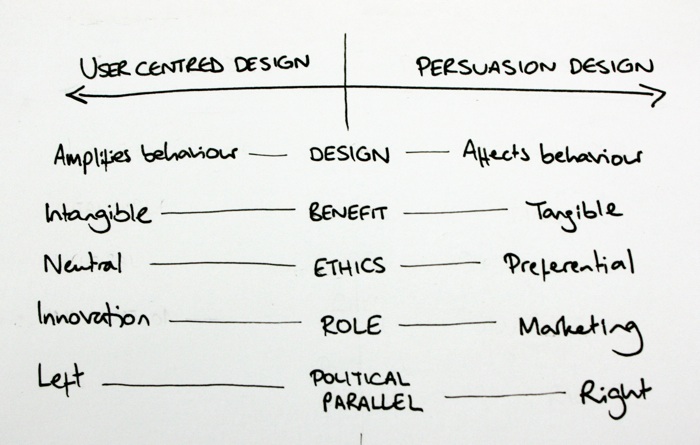
As with politics, one’s stance is a matter of preference and most mainstream modes are appropriate. The problems lie in the extremes: let’s call them radical UCD and radical persuasion design.
Radical UCD
Under radical UCD, the user’s priorities outweigh others. It’s here that we see the notion of design ‘dissolving into behaviour’ realised. Design becomes an ethically neutral activity whose role is to amplify and liberate the end user. The rewards are intangible, long-term and altruistic: we hope to engender loyalty and word of mouth referrals, but the effects are notoriously hard to measure.
However, as with the political equivalent, radical UCD is economically unrealistic and unworkable. At this extreme, design could only cause consensus-building timidity that reinforces current modes – an accusation already pointed at milder contemporary user-centred practice.
Radical persuasion design
Persuasion design doesn’t share UCD’s ethical neutrality. Instead, it makes an implicit but undeniable judgment that certain behaviours are preferable to others. We need only look at the vocabulary of persuasion design to see this. Jon Kolko’s infamous Johnny Holland article talks of design’s contribution “to the behaviour of the masses, [helping to] define the culture of our society.”
While I respect Jon’s intellect, I find this to be dangerous rhetoric from which we can draw uncomfortable parody: Fear not, huddled masses – the design elite will lead you to the promised land. Persuasion design’s assured ethical superiority is unfortunate. Although some of the cases put forward are compelling – guiding people toward better macroscopic decisions about environment, health etc – we must recognise that, for all the good deeds behaviour change can encourage, it is prone to murkier applications.
What privileges the designer to dictate desired behaviour? And since we’re for hire, does that mean we’re ethical relativists, bending people toward whatever agenda lines our pockets?
Whomever the paymaster, the common pattern I observe in digital persuasion design is that its values are uniformly technocratic. Science is better than faith. Action is better than reflection. Progress is better than the status quo. These values strike me as practically Futurist and, at the risk of invoking Godwin’s Law, I’m concerned that radical persuasion design is vulnerable to similar autocratic pitfalls as the Futurists themselves.
Persuasion design is marketing. UX isn’t.
I have struggled for months to unify my understanding of these two political wings, and now conclude that I cannot. I believe that persuasion design is not part of user experience design. It is marketing. Persuasion design prioritises business goals above those of the user, and its values are irreconcilable with empathy, the central value of UX.
That’s not to say that persuasion design isn’t highly valuable and attractive to business. After all, it matches the recognised business patterns of marketing, making its effects felt in tangible measures that UCD’s intangible altruism cannot: conversion rates, signups, and so on.
I subscribe to Peter Drucker‘s view that business has only two functions: innovation and marketing. Under this model, user experience design is innovation. It uncovers people’s needs and and gives makers the knowledge to develop new products and services that meet those needs.
This, finally, is why I disagree with Josh Porter’s assertion that UX is really just good marketing – however, my disagreement isn’t with his framing of marketing, but of user experience. As far as persuasion design is concerned, he is right – but the equation does not apply to UCD and UX.
Opinions and unwinnable arguments
I am of course straying close to two notoriously unwinnable arguments: semantics and politics. I have neither time nor inclination to enter into political debate or vanish down the rabbithole of Defining The Damn Thing, and I am all too aware that, like any model, the one I give is simplistic. It overlooks the complexities of authoritarianism and liberalism, which are not necessarily tied to economic left or right, and belies the greys that lie between black and white. I raise it instead as a way to highlight the risky territory I believe we are heading toward. All I ask is that the community considers these issues carefully and reaches its own conclusions. I’m happy if those differ from mine.
Even if my thoughts turn out to be at odds with those of the broader UX community, I’ll take heart from the words of Dieter Rams, who also took a stance against the involvement of persuasive techniques:
Braun categorically rejects the idea of motivating people to buy its products by adding features that toy with the psychological sub-terrain of the consumer’s consciousness. Braun refuses to swell sales by exploiting human frailties: neither its products nor its advertising use such seduction techniques.
Those who wish to employ persuasive techniques are welcome to do so. But my focus continues to be on striving to make better products by listening, not driving behaviour change. At times I will use tactics from the persuasion design toolkit, as I do with other tools of marketing, but I will do so only when I have fully considered the ethical implications. I hope that others will do the same.
[Minor edits to fix incorrect refs and typos, May 2017.]